


Citation Needed: Academic Discourse & That Essay
- Chris Gyford

- Jan 24
- 8 min read
Updated: Feb 7
Study to shew thyself approved unto God, a workman that needeth not to be ashamed, rightly dividing the word of truth. – King James Bible, 1999, 2 Timothy 2:15
A Biblical citation is not my usual go-to for opening a post here (indeed, I had to look up how to do it), but it seemed called for when responding to a recent, widely reported story about a third-year psychology student at Oklahoma University claiming to have received a failing grade on an assignment because she cited the Bible. The reasoning behind this flexing of my academic prowess is simply that the essay in question (read it here) does not in fact contain a single citation, Biblical or otherwise. The fact that few seemed to pick up on this is merely the most obvious indicator of the shockingly poor level of academic literacy evident in much of the surrounding media coverage.

“I was told to give my opinion on gender stereotypes and gender norms,” Fulnecky told a nodding Fox News host. That claim, like many advanced in her essay, does not withstand even minimal scrutiny. We know this because Turning Point USA released both her submission and the rubric against which it was assessed, apparently confident that their intended audience would not notice how comprehensively the documents undermine her account. The assignment was not an invitation to free-form opinion, nor was it an exercise in personal belief formation. It was a reaction paper, explicitly requiring substantive content evidencing that the assigned article had been read and a thoughtful engagement with its arguments. What Fulnecky submitted instead was a diffuse collection of unsupported assertions bearing little relation to the task she had actually been set.
If I remember correctly (she doesn’t), I could be wrong (she is), but I'm pretty sure um the main um point or kind of conclusion of the article was that it's um that gender binary is harmful for kids because they feel like they have to conform to one gender and to those the stereotypes in those genders (it wasn’t – read it here). – Samantha Fulnecky, News 9 Interview.
Reinforcing the most basic requirement of a reaction paper, namely that it be a reaction, the grading criteria allocates 10 of the 25 available points to demonstrating “a clear tie-in to the assigned article.” Despite claiming to have found the article by Jewell and Brown (2014) “very thought provoking,” there is little evidence that Fulnecky engaged with anything beyond the title of what she later claimed she was “pretty sure” was a journal article. Asserting at the outset that God-given gender roles “should not be considered ‘stereotypes,’” though it is unclear why the term is placed in scare quotes or what she understands it to mean, she goes on to state, also in scare quotes, that she is content to be “following gender ‘stereotypes’” because this is God’s plan. On this basis, she sees no problem with children being bullied into conformity, a phenomenon she later claims is not occurring and, in any case, is unnecessary, presumably because of the aforementioned plan. That such bullying is in fact occurring and is associated with poor mental health outcomes, which are central findings of the article she was meant to be responding to, goes entirely unmentioned in her paper. More striking still is her rejection of efforts to support diverse gender expressions in order to improve students’ confidence, alongside an argument against eliminating gender in society, positions which, notwithstanding her assertions, do not appear to be advanced anywhere in the assigned article. That she has failed to establish any meaningful tie-in to the text nor even evidenced she has read it, and has instead substantially misrepresented it where she attempts to do so fails to meet this criterion for substantive content.
I was, um, at my, um, my, my good friend. I was at her house, and we were about to go to a musical that, um, OU was putting on, or a play, and, um, I was like, “Oh, I have to do this assignment really quick. It’ll just take a second.” And then I read the topic and I was like, “Oh, this is gonna be so easy.” Like, you know, I have a very strong opinion on this topic, and then I wrote it in maybe, like, 30 minutes. It was really easy for me to come up with things to say. – Samantha Fulnecky, News 9 Interview.
A further 10 points were available for presenting “a thoughtful reaction or response to the article.” Although Fulnecky claims to have “thoroughly evaluated gender and the role it plays in our society” in response to the paper, this evaluation is not evident in either her writing or her commentary on it. As a tennis champion and pre-medical student, she was well placed to draw on her own lived experience in order to contribute something of interest, an approach explicitly encouraged by the rubric, to the emerging asymmetry in gender expectations and mental health outcomes discussed by Jewell and Brown (2014). They note, for example, that athletic and independent girls may experience improved social outcomes, though not necessarily improved mental health, despite diverging from traditional models of femininity. Fulnecky, however, fails to even address what would seem to be a point (albeit one not outlined in the article's abstract) with high personal relevance. Instead, she launches into tangents from tangents rehashing tired old culture war talking points around gender fluidity, free speech, and a detailed, though seemingly inaccurate, analysis of the correct translation of key Hebrew terminology. These arguments are drawn entirely from her own (or more likely her pastor's) unsourced and unsupported interpretation of scripture, which she may or may not have actually read. Indeed, far from responding to the assigned article, Fulnecky appears instead to be reacting to discussion posts she found “frustrating,” written by classmates whom, along with the article’s authors, she characterizes as “cowardly and insincere” for “trying to conform to the same mundane opinion” in order not to “step on people’s toes,” as well as to her instructor’s transgender identity, which she describes as a severely harmful demonic lie promoted by Satan and society. This persistent failure to offer a thoughtful response to the article itself also fails to meet this criterion for substantive content.
Um, well, I think even though they're saying that my writing isn't good and things like that, um I think we can all agree that it doesn't deserve a zero um if you turn in the assignment. So, um, that's one, um, kind of thought that I have with that. And then the other thing is just that it it doesn't botheer me at all that people are saying that online because I never claimed to be an English major or, you know, good at writing or anything like that. I don't think I'm a bad writer, but, you know, that's not what I'm going to school for. And all my classes are very rigorous science classes. – Samantha Fulnecky, News 9 Interview.
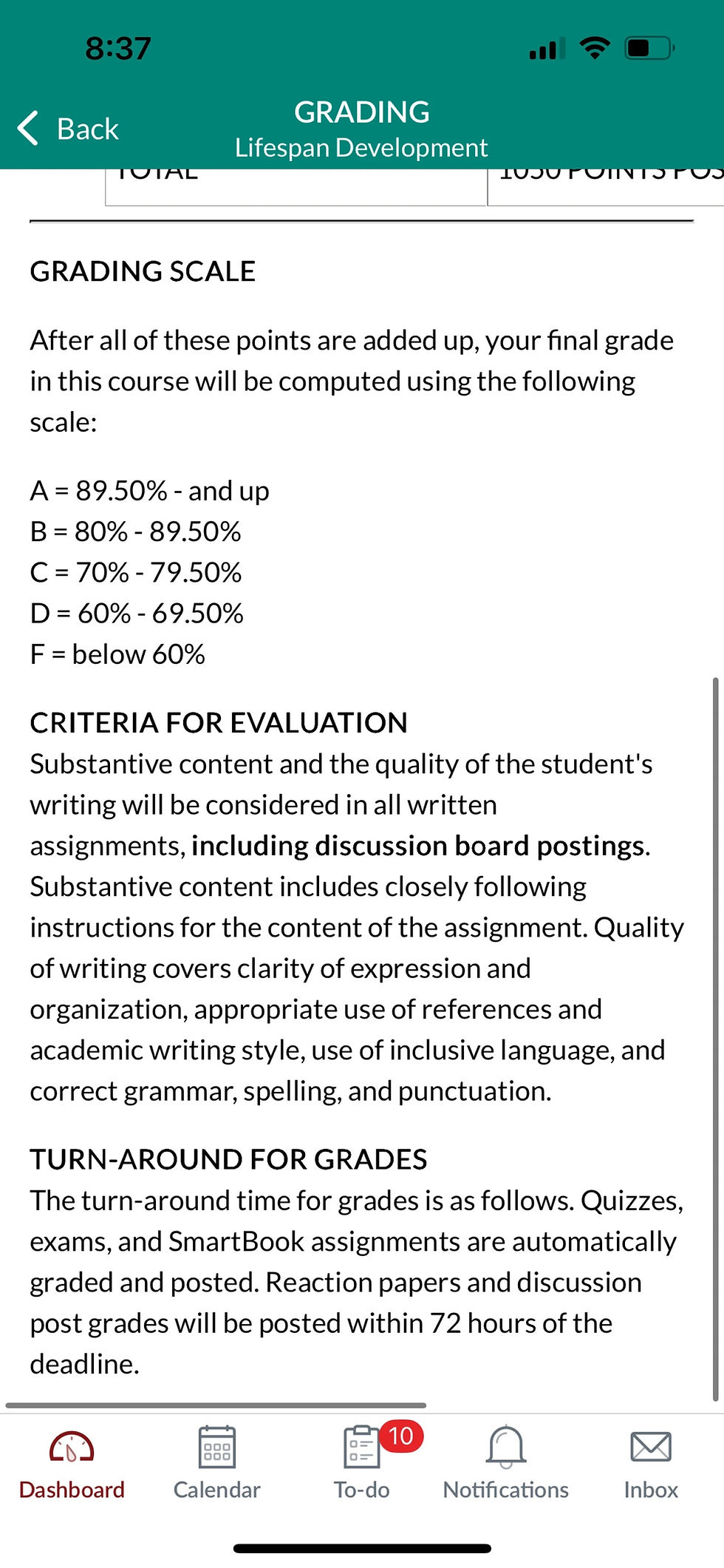
The final five points were awarded for clarity of writing, a criterion that explicitly requires ideas to be organized into a coherent academic discussion, yet which Fulnecky and her defenders have claimed was vague because the rubric failed to mention that calling an empirical psychology article “demonic,” substituting prayer for analysis, or asserting that peer pressure around gender “does not exist” without evidence would be unacceptable. Even if the conventions had not been spelled out, that excuse would still fail: a third-year psychology student should not need to be told that an academic reaction paper is not the place for sermons, culture-war rhetoric, or unsupported metaphysical claims, any more than they need to be told not to submit their assignment in haiku or High Elvish. As it happens, however, those expectations were explicitly stated in the course description, a document Fulnecky and many commentators evidently did not bother to read. The essay’s lack of conceptual precision, evident in its repeated misuse of terms like “stereotype” and outright denial of peer pressure discussed in the article; its absence of structured argumentation, as it moves from anecdote to theology to moral condemnation without engaging the study’s methods or findings; and its failure to communicate ideas in a clear, disciplined academic manner all violate the stated requirement for “clarity of expression and organization.” Its total lack of citations, complete failure to substantively engage the assigned article, and reliance on polemical, belief-based assertions rather than evidence-based reasoning violate the requirement for “appropriate use of references and academic writing style.” Finally, its characterization of gender diversity as “lies being spread from Satan” violates the requirement for “use of inclusive language.” Fulnecky’s defence that she is “not an English major,” and that this is “not what she is going to school for,” only underscores the misunderstanding I alluded to in my introduction: mastering academic writing conventions is not an optional accessory to “rigorous science,” but a basic condition to participating in it. I had um one of my professors, I'm taking one of his classes right now. Um, he um sent me an email right when all this started happening and he said, "I'm fully in support of you. Um, I really, you know, admire your courage and things like that." And said that he was praying for me, and I I really appreciated that. I look up to him a lot. And then, um, I've gotten a couple other emails from professors at OU saying that they're also in support of me and that, um, they appreciate what I'm doing. So, that's been really encouraging. – Samantha Fulnecky, News 9 Interview.
Fulnecky’s opinion that she “should’ve gotten a 100,” as she has “gotten a 100 on every single essay [she’s] written in that class,” and "as long as it wasn't a summary of the article then we would basically get 100 on it if it met the word count," shows a shocking lack of regard for her own educational development, and is seemingly contradicted (as seems characteristic) by her later claim that she had been given five out of ten on a similar previous assignment by the same teacher. And while many commentators have offered their own gradings of the paper based on the available rubric (but not the course description), I will refrain; As I am not a teacher on that course, in that department, of that university, such an assessment would be ill-informed and unprofessional. However, that two separate teachers who do meet those criteria agreed on the same conclusion and provided very well written justification for that conclusion strongly suggests to me that it was probably warranted. And in one final revelation (if you'll pardon the expression), it seems from that feedback, despite what Fulnecky and the media have claimed, that final conclusion may not have been a zero nor even a failing grade but rather an "incomplete". Now, due to the aforementioned reasons (not being a teacher on that course, in that department, of that university) I don't know exactly what that would mean in this context, but it is generally understood to offer the opportunity to revise and resubmit work in light of the feedback provided. This is what we in education like to call learning, that thing Fulnecky claims to be at school for, but, like most of her claims completely fails to evidence.


Bibliography:
Jewell, J.A. and Brown, C.S. (2014). Relations Among Gender Typicality, Peer Relations, and Mental Health During Early Adolescence. Social Development, 23(1), pp.137–156. doi:10.1111/sode.12042.
King James Bible (1999). Available at: https://www.biblegateway.com/passage/?search=2%20Timothy%202&version=AKJV (Accessed: 17 December 2025).
Comments